
Back, Neck & Spine
Whiplash / Neck Sprain
What physiotherapy assessment for whiplash / neck sprain involves, and how care is decided.
This page is patient education — it is not a diagnosis, and it does not replace being assessed.

Common symptoms and signs
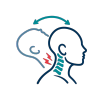
Whiplash describes a neck strain from a rapid back-and-forth movement, most often after a vehicle collision. Symptoms frequently appear a day or two later rather than immediately.
- Neck pain and stiffness that developed within a day or two of the incident
- Headache, often starting at the base of the skull
- Pain or tightness across the shoulders and upper back
- Difficulty turning the head, and sometimes dizziness or difficulty concentrating


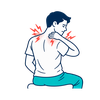
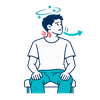
These are the things people commonly describe. They are not a checklist for diagnosing yourself — the same symptoms can come from more than one problem, which is what an assessment is for.

Possible causes and contributing factors
Factors commonly associated with this problem. Association is not the same as cause — the same problem has different contributors in different people, and finding yours is part of what assessment does.
- A rapid acceleration–deceleration movement of the neck, commonly in a collision
- A fall or a sporting impact
- Guarding and reduced movement in the days afterwards
- Anxiety about the incident, which commonly affects how symptoms settle
When to seek help
When to consider physiotherapy
- The problem has not settled over a few weeks, or keeps returning
- It is limiting work, sleep, driving or looking after your family
- You are avoiding activity because you are not sure what is safe
- You have been told to "live with it" and want it properly assessed
You do not need to be certain this is you. If you are unsure, describe it to the practice and you will be told plainly whether physiotherapy is the right next step.

How physiotherapy assesses this problem
The same assessment-led approach applies whatever the problem turns out to be. Nothing is treated before it has been assessed.
Step 1: History
What happened, how it behaves through the day, what makes it better or worse, and what it is currently stopping you doing.
Step 2: Movement and strength testing
How the area moves, how much it can produce and tolerate, and how the surrounding joints and muscles are compensating.
Step 3: Functional testing
The specific tasks that are difficult — reaching, stairs, walking, gripping, sitting — tested rather than described.
Step 4: Explanation and plan
What the findings suggest in plain language, including what remains uncertain, and what the first stage of care would involve.




Treatment approach
What care works on, rather than what it promises. What is appropriate for you is decided at the assessment, not from a website.
Identifying the loads, positions and activities involved, and adjusting them deliberately rather than resting completely.
Working on the range and quality of movement that has been lost, at a pace the area can tolerate.
Progressive strengthening so the area can take the load your daily life or sport actually asks of it.
Staged return to work, prayer, driving, lifting or sport, with the criteria for progressing made clear.


Treatments that may be used
These are techniques a physiotherapist may use. Listing one here is not a recommendation, and none of them is decided before you have been assessed.
 Manual Therapy
Hands-on assessment and treatment of joints and soft tissue, used alongside movement and rehabilitation rather than on its own.
 Dry Needling
A fine needle applied to muscle tissue as part of a wider physiotherapy plan. It is a technique within treatment, not a treatment in itself.
 Clinical Pilates
Guided, progressive exercise adapted to a clinical problem — prescribed by a physiotherapist, not run as a general fitness class.
 IASTM (Soft-Tissue Mobilisation)
Instrument-assisted soft-tissue mobilisation — a tool used to apply pressure to soft tissue, as one part of a hands-on treatment approach.
Care & services
Where this problem is looked after, and the programmes it can lead into. The same practice and the same records, wherever the care happens.
 Musculoskeletal / Orthopaedic
The area of physiotherapy this problem sits within.
 At the clinic
Johar Town, Lahore
 Home physiotherapy
Treatment at your home in Lahore
 Online physiotherapy
Guided sessions remotely
Who would treat this?
You do not choose a physiotherapist. Describe the problem, and the practice assigns the one whose clinical focus fits it — then reviews that as the picture becomes clearer.
Patient experience
What other patients say
Consented patient story pending
Layout preview · Video not yet availableConsented patient story pending
Layout preview · Video not yet availableConsented patient story pending
Layout preview · Video not yet availableCommon questions
About this problem and assessment — draft copy for clinical review, not personal medical advice.
Do I need a scan before I book physiotherapy?
Usually not. Most back and neck problems are assessed with your history and movement first. If your story or examination suggests something that needs imaging, a doctor arranges that — a scan on its own does not always change what physiotherapy can safely start with.
Should I stay in bed until the pain settles?
Complete bed rest is rarely the best approach. For most non-specific back and neck pain, staying generally active within what you can tolerate, and adjusting painful loads, is consistent with current guidance — while red-flag symptoms still need medical assessment first.
Why did neck pain start days after a car accident?
Symptoms commonly appear 24–72 hours after whiplash as inflammation and guarded movement set in. Early assessment still helps set safe activity; new numbness, weakness or severe headache needs urgent medical review.
Booking this practice
How do I book an appointment?
Message the practice on WhatsApp with a short description of your problem. The coordinator will reply during clinic hours to arrange a time.
Can I choose which physiotherapist I see?
Booking is with the practice rather than an individual. After you describe the problem, the practice assigns the physiotherapist whose clinical focus fits it. You can read about the team on the physiotherapists page.
Questions about your own case
How long recovery takes, whether you need a scan, and what is safe to do in the meantime all depend on your assessment. Those are worth asking a physiotherapist rather than a website — describe your situation and you will get an answer about you.



Need help with whiplash / neck sprain?
Describe it on WhatsApp. You do not need a diagnosis to get assessed.